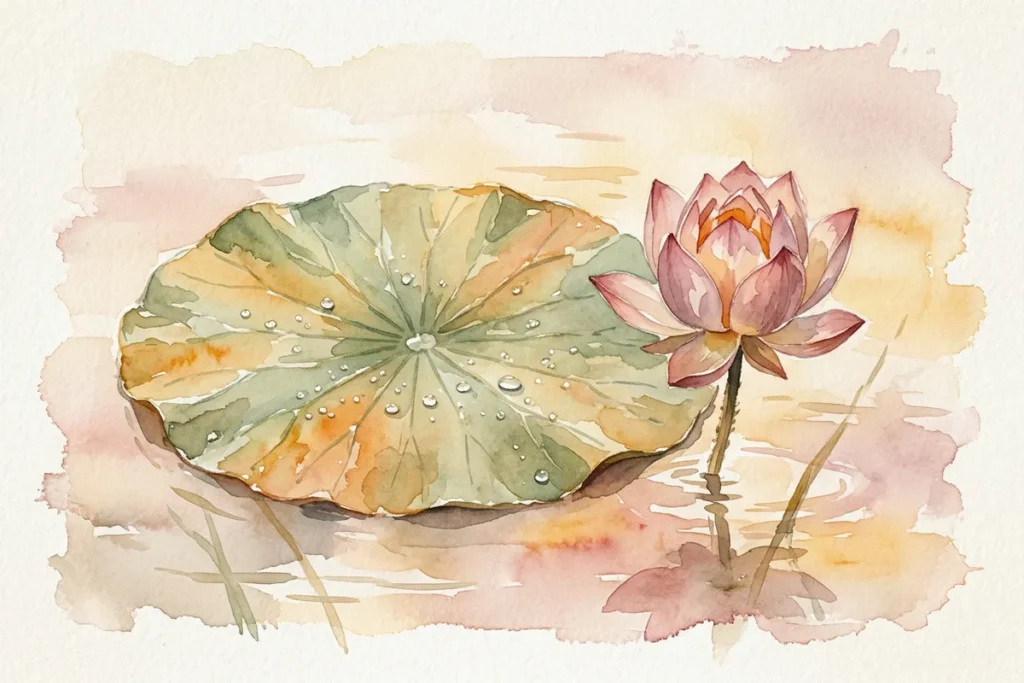
Like a lotus leaf
Letting go and acting are not opposites. Krishna shows how they meet.
Today's key verse
ब्रह्मण्याधाय कर्माणि सङ्गं त्यक्त्वा करोति यः ।
लिप्यते न स पापेन पद्मपत्रमिवाम्भसा ॥
brahmaṇyādhāya karmāṇi saṅgaṃ tyaktvā karoti yaḥ
lipyate na sa pāpena padmapatramivāmbhasā
He who acteth, placing all actions in the Eternal, abandoning attachment, is unaffected by sin as a lotus leaf by the waters.
Chapter 5: Letting go while still acting Chapter summary
अर्जुन उवाच ।
संन्यासं कर्मणां कृष्ण पुनर्योगं च शंससि ।
यच्छ्रेय एतयोरेकं तन्मे ब्रूहि सुनिश्चितम् ॥
arjuna uvāca
saṃnyāsaṃ karmaṇāṃ kṛṣṇa punaryogaṃ ca śaṃsasi
yacchreya etayorekaṃ tanme brūhi suniścitam
Arjuna said: Renunciation of actions Thou praisest, O Krishna, and then also yoga. Of the two which one is the better? That tell me conclusively.
श्रीभगवानुवाच ।
संन्यासः कर्मयोगश्च निःश्रेयसकरावुभौ ।
तयोस्तु कर्मसंन्यासात्कर्मयोगो विशिष्यते ॥
śrībhagavānuvāca
saṃnyāsaḥ karmayogaśca niḥśreyasakarāvubhau
tayostu karmasaṃnyāsātkarmayogo viśiṣyate
The Blessed Lord said: Renunciation and yoga by action both lead to the highest bliss; of the two, yoga by action is verily better than renunciation of action.
Something to think about
Where could you act fully today without being stained by worry or ego?
The day's introduction and question were written by Satsang Space. The verses are from Annie Besant's translation.
Sources
- The Bhagavad-Gita, translated by Annie Besant (4th edition, 1922), on Wikisource. The Sanskrit text and the English translation are copied word for word from this edition. Besant's footnotes are left out.
- The transliteration is made from the Sanskrit using the standard IAST system.
Annie Besant's translation was first published in 1895 and is in the public domain. Teachers and traditions explain the Gita in many ways; the summaries here only describe what the verses say.