Uses your device’s built-in voice.
Learning a few key words makes it much easier to understand Hindu ideas, texts and festivals. Use the search to find a term, or switch to flashcards to test yourself.
- Brahman Ideas
- The ultimate reality that underlies everything, as described in the Upanishads.
- Atman Ideas
- The true, inner self. Many schools of Hindu thought teach that atman is one with Brahman.
- Dharma Ideas
- Right conduct and duty, which can depend on a person’s stage and situation in life.
- Karma Ideas
- Action, and the principle that actions have consequences, in this life or a future one.
- Samsara Ideas
- The cycle of birth, death and rebirth.
- Moksha Ideas
- Liberation from the cycle of rebirth; often seen as the highest goal of life.
- Bhakti Practice
- Loving devotion to God, described in the Bhagavad Gita as one path to liberation.
- Puja Practice
- Worship, at home or in a temple, often with offerings such as flowers, light, incense and food.
- Murti Practice
- A sacred image or statue of a deity, used as a focus for worship.
- Mandir Practice
- A Hindu temple: a place of worship and community.
- Mantra Practice
- A sacred sound, word or phrase that is spoken, chanted or repeated silently.
- Japa Practice
- Repeating a mantra many times, often while counting on a mala.
- Mala Practice
- A string of beads, traditionally 108, used to count repetitions of a mantra.
- Yoga Practice
- A family of disciplines for uniting body, mind and spirit; classical yoga is described in Patanjali’s Yoga Sutras.
- Vedas Texts
- The oldest Hindu scriptures, revered across traditions.
- Upanishads Texts
- Philosophical texts that explore the self and ultimate reality.
- Bhagavad Gita Texts
- A conversation between Prince Arjuna and Krishna, found within the Mahabharata.
- Ramayana Texts
- An epic telling the story of Rama, Sita, Lakshmana and Hanuman.
- Mahabharata Texts
- A vast epic about the Pandava and Kaurava families and the great war between them.
- Diya Festivals
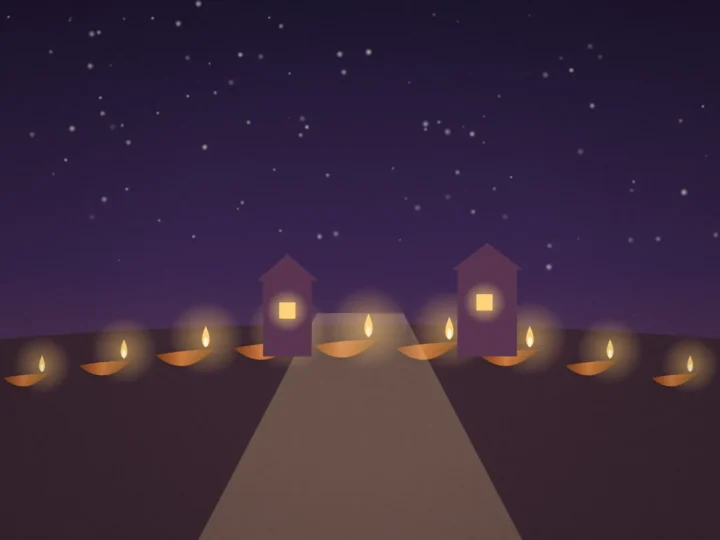
- A small oil lamp, lit especially at Diwali, the festival of lights.
- Rangoli Festivals
- Colourful patterns made on the floor, often at the entrance of a home, especially at festival time.
How to use this glossary
- Start small: learn five words a week, beginning with dharma, karma, puja, mantra and murti.
- Use the flashcards: say the definition aloud before turning the card.
- See the words in context: follow the links below to guides where each word appears.
Words by theme
- Big ideas: Brahman, atman, dharma, karma, samsara, moksha. See karma, samsara and moksha.
- Worship: puja, murti, arti, prasad, mandir. See puja at home and visiting a Hindu temple.
- Sound and prayer: mantra, Om, japa, mala. See mantras.
- Texts: Vedas, Upanishads, Bhagavad Gita, Ramayana, Mahabharata. See the Bhagavad Gita.
- Practice: yoga, dhyana (meditation), pranayama (breath regulation). See the roots of yoga.
A note on spelling
Sanskrit words can be written in English in several ways. You may see Shiva or Siva, Krishna or Krsna, Diwali or Deepavali. Scholarly books often use special marks (such as ā or ṣ) to show exact pronunciation. All refer to the same terms.
A note on meanings
These definitions are short and general. Many terms carry several meanings, and different Hindu traditions understand them in different ways.