His form
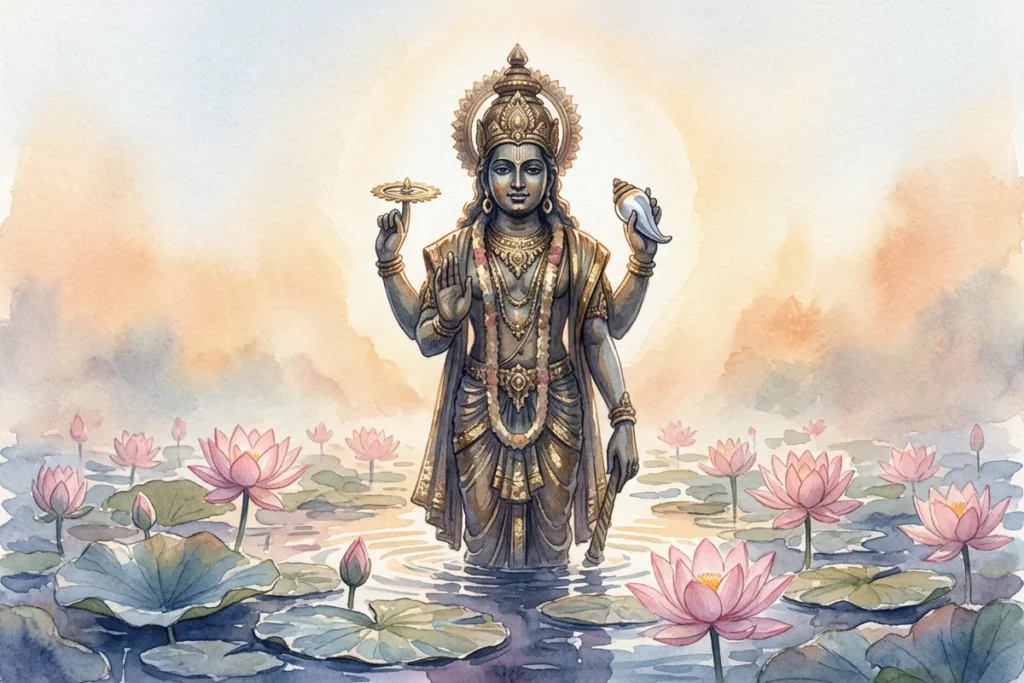
Vishnu is shown with blue skin and four arms holding a conch, a discus, a mace and a lotus. He rests on the great serpent Shesha in the cosmic ocean, with his wife Lakshmi. His vehicle is the eagle Garuda.1
The ten avatars
The best-known list, the Dashavatara, has ten avatars: Matsya (fish), Kurma (tortoise), Varaha (boar), Narasimha (man-lion), Vamana (dwarf), Parashurama, Rama, Krishna, the Buddha or Balarama (lists differ), and Kalki, who is still to come.2
Why he comes
The Bhagavad Gita explains that God takes birth age after age to protect the good and restore dharma. Our page on the verse Yada Yada Hi Dharmasya has the text.3
Prayers
Try the aarti Om Jai Jagdish Hare or the mantra Om Namo Bhagavate Vasudevaya.1
Vishnu in the Trimurti
In a well-known grouping called the Trimurti, Brahma creates, Vishnu preserves and Shiva dissolves, so that the universe can begin again. For Vaishnavas, though, Vishnu is not one of three but the supreme God, the source of everything.41
The avatars one by one
- Matsya, the fish: saves Manu and the seeds of life from a great flood.
- Kurma, the tortoise: supports the mountain used to churn the cosmic ocean.
- Varaha, the boar: lifts the earth from the depths of the ocean.
- Narasimha, the man-lion: protects the young devotee Prahlada, a story told at Holi.
- Vamana, the dwarf: covers the universe in three steps.
- Parashurama: the warrior with an axe, remembered at Parshuram Jayanti.
- Rama: the ideal king of the Ramayana, celebrated at Ram Navami.
- Krishna: the teacher of the Gita, celebrated at Janmashtami.
- The Buddha or Balarama: lists differ by region and tradition.
- Kalki: expected at the end of the present age.
The Vaishnava tradition
Vaishnavism, the worship of Vishnu and his avatars, is one of the largest Hindu traditions. It includes many communities, from the Sri Vaishnavas of South India, linked with the teacher Ramanuja, to the Krishna devotion of Bengal and Vrindavan. Famous Vishnu temples include Tirupati and Srirangam.15
Sources
- Wikipedia: Vishnu
- Wikipedia: Dashavatara
- Wikipedia: Bhagavad Gita
- Wikipedia: Trimurti
- Wikipedia: Hindu denominations
Hindu traditions are many and varied; families and teachers may explain these ideas differently. Last reviewed 19 November 2026.