A warrior loses heart
We meet the two armies and Arjuna, who suddenly cannot bring himself to fight his own family. The whole Gita grows out of this moment of doubt.
Today's key verse
सञ्जय उवाच ।
एवमुक्त्वाऽर्जुनः सङ्ख्ये रथोपस्थ उपाविशत् ।
विसृज्य सशरं चापं शोकसंविग्नमानसः ॥
sañjaya uvāca
evamuktvā'rjunaḥ saṅkhye rathopastha upāviśat
visṛjya saśaraṃ cāpaṃ śokasaṃvignamānasaḥ
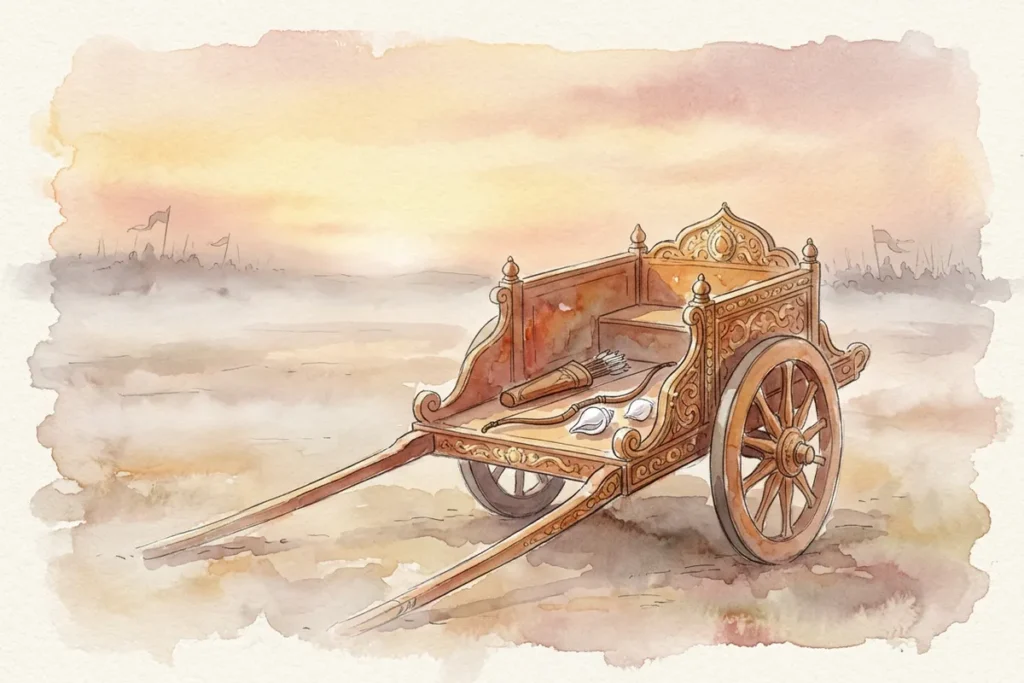
Sanjaya said: Having thus spoken on the battle-field, Arjuna sank down on the seat of the chariot, casting away his bow and arrow, his mind overborne by grief.
Chapter 1: Arjuna's sorrow Chapter summary
धृतराष्ट्र उवाच ।
धर्मक्षेत्रे कुरुक्षेत्रे समवेता युयुत्सवः ।
मामकाः पाण्डवाश्चैव किमकुर्वत सञ्जय ॥
dhṛtarāṣṭra uvāca
dharmakṣetre kurukṣetre samavetā yuyutsavaḥ
māmakāḥ pāṇḍavāścaiva kimakurvata sañjaya
Dhritarâshtra said: On the holy plain, on the field of Kuru, gathered together, eager for battle, what did they, O Sanjaya, my people and the Pândavas?
सञ्जय उवाच ।
दृष्ट्वा तु पाण्डवानीकं व्यूढं दुर्योधनस्तदा ।
आचार्यमुपसङ्गम्य राजा वचनमब्रवीत् ॥
sañjaya uvāca
dṛṣṭvā tu pāṇḍavānīkaṃ vyūḍhaṃ duryodhanastadā
ācāryamupasaṅgamya rājā vacanamabravīt
Sanjaya said: Having seen arrayed the army of the Pândavas, the Prince Duryodhana approached his teacher, and spake these words:
Something to think about
When have you felt stuck between two duties? What did it feel like?
The day's introduction and question were written by Satsang Space. The verses are from Annie Besant's translation.
Sources
- The Bhagavad-Gita, translated by Annie Besant (4th edition, 1922), on Wikisource. The Sanskrit text and the English translation are copied word for word from this edition. Besant's footnotes are left out.
- The transliteration is made from the Sanskrit using the standard IAST system.
Annie Besant's translation was first published in 1895 and is in the public domain. Teachers and traditions explain the Gita in many ways; the summaries here only describe what the verses say.