Hindu
Ganesh Chaturthi
Also called Vinayaka Chaturthi, Ganeshotsav, Vinayagar Chathurthi
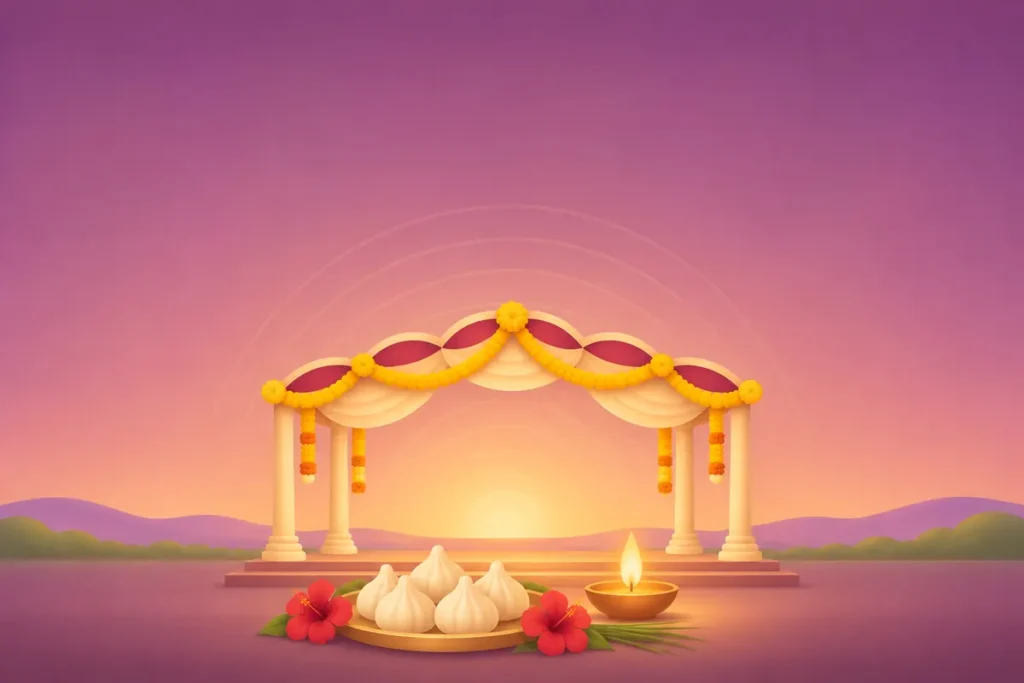
Ganesh Chaturthi celebrates the birth of Ganesha, the elephant-headed god of beginnings, wisdom and the remover of obstacles. Families and communities bring home clay images, worship them with modaks, songs and aarti for one and a half to ten days, then immerse them in water with the cry “Ganpati Bappa Morya!”.
Why it is celebrated
Ganesha is worshipped before any new beginning. His festival is a welcome of the god into homes and neighbourhoods.
In 1893 Bal Gangadhar Tilak promoted public Ganeshotsav in Pune to bring people together during the freedom movement, and the public celebration spread from there.
The stories behind it
How Ganesha got his head
Parvati made a boy from turmeric paste and set him to guard her door. When Shiva returned and was refused entry, he struck off the boy’s head. Seeing Parvati’s grief, Shiva promised to restore him and gave him the head of the first creature found, an elephant, making him leader of his ganas.
The race around the world
Ganesha and his brother Kartikeya were challenged to race around the world. Kartikeya flew off on his peacock. Ganesha simply walked around his parents, saying that they were his whole world, and won.
What people do
- Bringing home a clay murti and installing it with prana pratishtha
- Daily aarti, often with the Marathi “Sukhakarta Dukhaharta”
- Offering modaks, durva grass and red flowers
- Public pandals (mandals) with large murtis and decorations
- Visarjan (immersion) on the 1.5th, 3rd, 5th, 7th or 10th day
- Not looking at the moon on Chaturthi night in many traditions
Across India and beyond
Ganeshotsav, with Mumbai’s Lalbaugcha Raja and Pune’s Dagdusheth
Chovoth, a family festival
Vinayaka Chaturthi in every home
Joining in for the first time
- Pandals welcome visitors; queues at famous ones can last hours
- Choose a clay or natural-material murti and immerse it at home or in an artificial tank to protect rivers and seas
Ganesh Chaturthi in 2027
Ganesh Chaturthi 2027 falls on Saturday 4 September 2027, according to the Government of India’s official list of holidays for 2027.
| Date (2027) | Day |
|---|---|
| Sat 4 Sep | Ganesh Chaturthi |
An eco-friendly Ganesh Chaturthi
- Choose an unpainted clay murti, or one coloured with natural dyes.
- Immerse it in a bucket or tub at home and use the clay in your garden.
- Decorate with flowers and reusable materials instead of plastic.
Children may enjoy the story Ganesha and the race around the world.
Dates from the Government of India, Department of Personnel & Training: holidays for central government offices in Delhi/New Delhi, 2027 (O.M. No. 12/2/2023-JCA, 16 July 2026). Festivals follow the Hindu lunar calendar, so dates change every year and can differ by a day between regions and countries. For exact timings, ask your local temple or community.
Questions people ask
Why not look at the moon?
A story says the moon laughed at Ganesha and was cursed; many avoid seeing the moon that night.
Read next
Sources
Customs differ between families, communities and regions. This page describes common practice; your family or temple may do things differently.