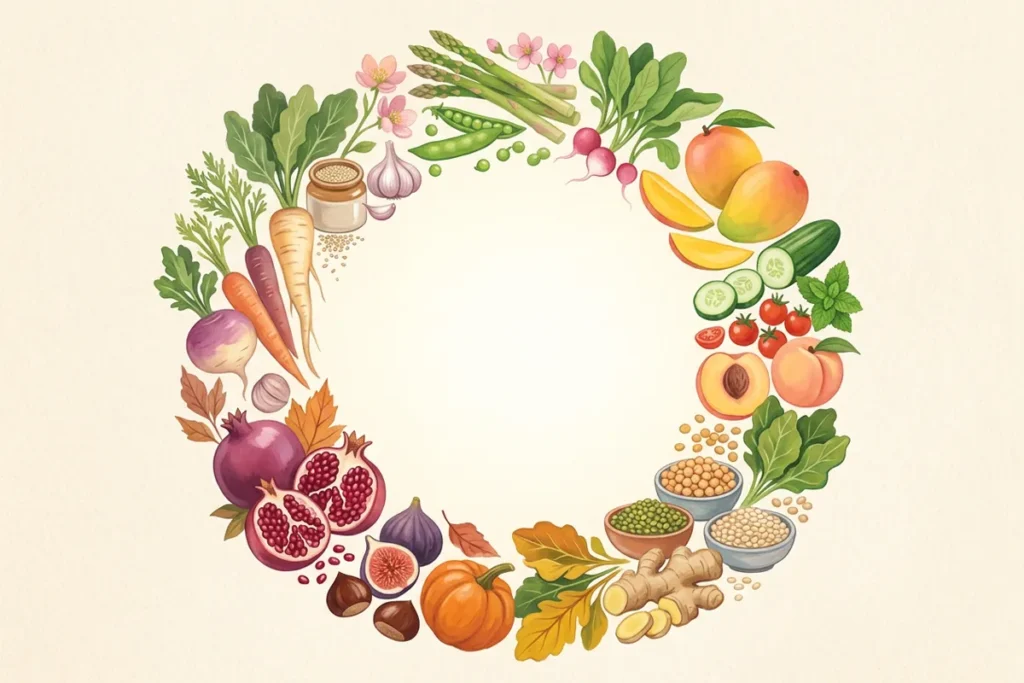
Eating with the seasons
Ayurveda changes food and habits with the seasons, a practice called ritucharya. Its classical calendar follows India's weather, so we show the seasons for your hemisphere.
Your season now
—
Favour
Do
Why the dates need adjusting
The classical texts describe six seasons of about two months each. Their dates follow India, where summer falls around May to July. In Sydney those months are winter. So on this site the seasons follow your hemisphere, six months apart.
Go by the weather where you live as much as the calendar. A cold snap in spring calls for warming food.
The six seasons
Late winter (Shishira)
About mid-Jul to mid-Sep (southern hemisphere)About mid-Jan to mid-Mar (northern hemisphere)
Cold and dry. Digestion is strong, and kapha starts to build up.
- Favour
- Warm, nourishing meals: grains, lentils and pulses, ginger, milk and ghee, and some sour foods.
- Go easy on
- Light, cold and dry food, and cold drinks.
- Do
- Oil massage, warm baths, sunshine and warm clothes.
- Avoid
- Cold wind and late nights.
Spring (Vasanta)
About mid-Sep to mid-Nov (southern hemisphere)About mid-Mar to mid-May (northern hemisphere)
Warming up after the cold. Kapha is at its peak, and digestion is weaker.
- Favour
- Light, easy-to-digest food, with bitter, pungent (spicy) and astringent tastes. A little honey.
- Go easy on
- Heavy, cold, very sweet or sour food, and yoghurt (curd).
- Do
- Regular exercise, warm baths and dry massage.
- Avoid
- Daytime sleep.
Summer (Grishma)
About mid-Nov to mid-Jan (southern hemisphere)About mid-May to mid-Jul (northern hemisphere)
Hot and draining. Digestion is mild, and energy is lower.
- Favour
- Light, sweet, cooling and watery food. Plenty of water, buttermilk and fresh juices.
- Go easy on
- Salty, sour and very spicy food, and alcohol.
- Do
- Stay cool, wear light clothes and rest in the heat of the day.
- Avoid
- Hard exercise in the heat.
Rainy season (Varsha)
About mid-Jan to mid-Mar (southern hemisphere)About mid-Jul to mid-Sep (northern hemisphere)
Damp and changeable. Vata is disturbed and digestion is weak.
- Favour
- Warm, freshly cooked food: soups, and boiled water. A little sour and salty taste is fine.
- Go easy on
- Too much raw food or cold liquid.
- Do
- Keep warm and dry, and use oil massage.
- Avoid
- Getting wet, daytime sleep and hard work.
Autumn (Sharat)
About mid-Mar to mid-May (southern hemisphere)About mid-Sep to mid-Nov (northern hemisphere)
Warm days after the rains. Pitta is high, and digestion picks up.
- Favour
- Sweet, bitter, light and cooling food: wheat, green gram (mung) and a little honey.
- Go easy on
- Hot, very spicy, fried and oily food, and yoghurt (curd).
- Do
- Eat only when hungry and keep cool in the evening.
- Avoid
- Daytime sleep and overeating.
Early winter (Hemanta)
About mid-May to mid-Jul (southern hemisphere)About mid-Nov to mid-Jan (northern hemisphere)
Cool and settled. Strength and digestion are at their best.
- Favour
- Nourishing, warm food: new rice, milk, ghee, sesame and root vegetables, with sweet, sour and salty tastes.
- Go easy on
- Light, cold and dry food, and cold drinks.
- Do
- Exercise, oil massage, warm water and sunshine.
- Avoid
- Cold wind and daytime sleep.
Seasons, foods and habits from the classical seasonal regimen as summarised by Thakkar et al. (Ayu, 2011). Months are approximate.
At the change of season
Ayurveda pays special attention to the junction between seasons (ritusandhi), when the body is adjusting 1. Change your food and routine gradually over a week or two rather than all at once.
Sources
- Ritucharya: answer to the lifestyle disorders, Thakkar et al., Ayu 2011
- Australian Dietary Guidelines review, NHMRC
Last reviewed 18 November 2026. Satsang Space shares general wellbeing information, not medical advice.