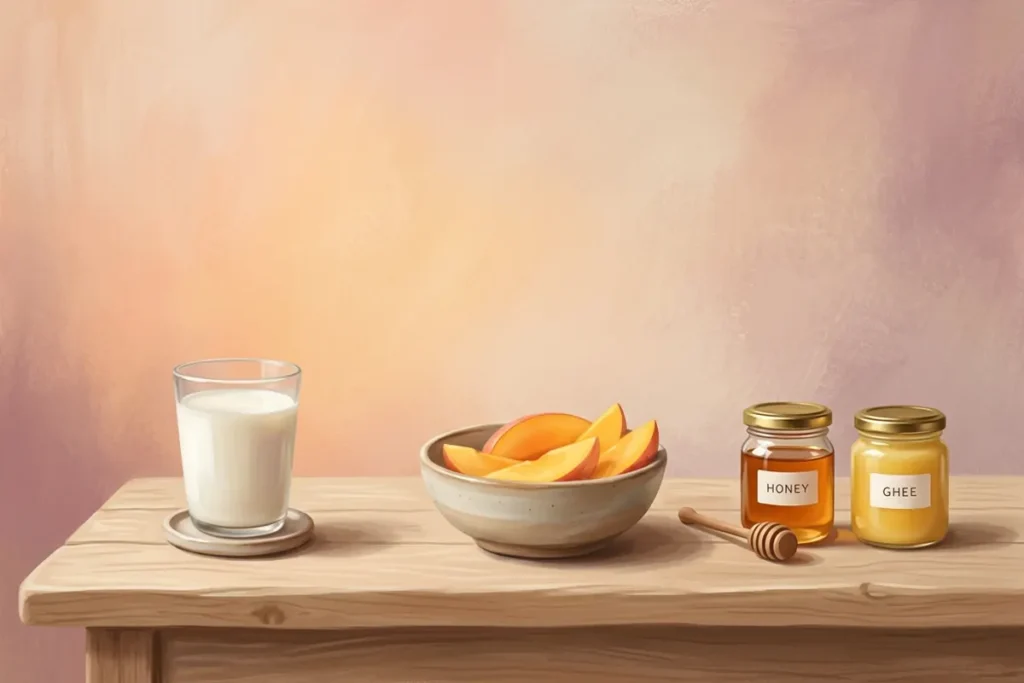
Food combinations
Ayurveda teaches that some foods don't suit each other, or don't suit a certain time, place or person. It calls this viruddha ahara, incompatible food Charaka, Sutra 26/81–101.
More than "don't mix A and B"
The texts describe many kinds of mismatch, not just pairs of foods 1:
- Time: cold, dry food in winter, or hot, spicy food in summer.
- Place: heavy, oily food in a damp climate.
- Amount: honey and ghee in exactly equal amounts.
- Order: eating when not hungry, or when far too hungry.
- Cooking: food that is undercooked, overcooked or burnt.
- Liking: eating food you find unpleasant.
Vegetarian examples in the texts
- Sour fruits, such as mango, tamarind, pomegranate or amla, taken with milk.
- Milk taken after radish or garlic.
- Some pulses, such as urad and horse gram, with milk.
- Honey and ghee in equal amounts, heated honey, or hot water straight after honey.
Charaka Samhita, Sutra 26/82–84 1; on heating honey, Sutra 27 2.
Curd (yoghurt)
The texts advise against eating curd at night or heating it, and suggest taking it with ghee, sugar, mung soup, honey or amla Charaka, Sutra 7/61–62.
A sensible way to use this
The texts themselves say these effects are softened by habit, small amounts, strong digestion, youth and exercise Charaka, Sutra 26/104–106. So there is no need to worry about every meal. If a combination doesn't agree with you, simply notice it and adjust.
Sources
- Atreyabhadrakapyiya Adhyaya (tastes and incompatible food), Charaka Samhita, Sutra 26
- Annapanavidhi Adhyaya (food and drink), Charaka Samhita, Sutra 27
- Naveganadharaniya Adhyaya (natural urges), Charaka Samhita, Sutra 7
Last reviewed 18 November 2026. Satsang Space shares general wellbeing information, not medical advice.