A fable from the Panchatantra, retold for children in our own words. The Panchatantra is an ancient Indian collection of animal stories traditionally attributed to the scholar Vishnu Sharma. This story comes from collections of Panchatantra-style fables.
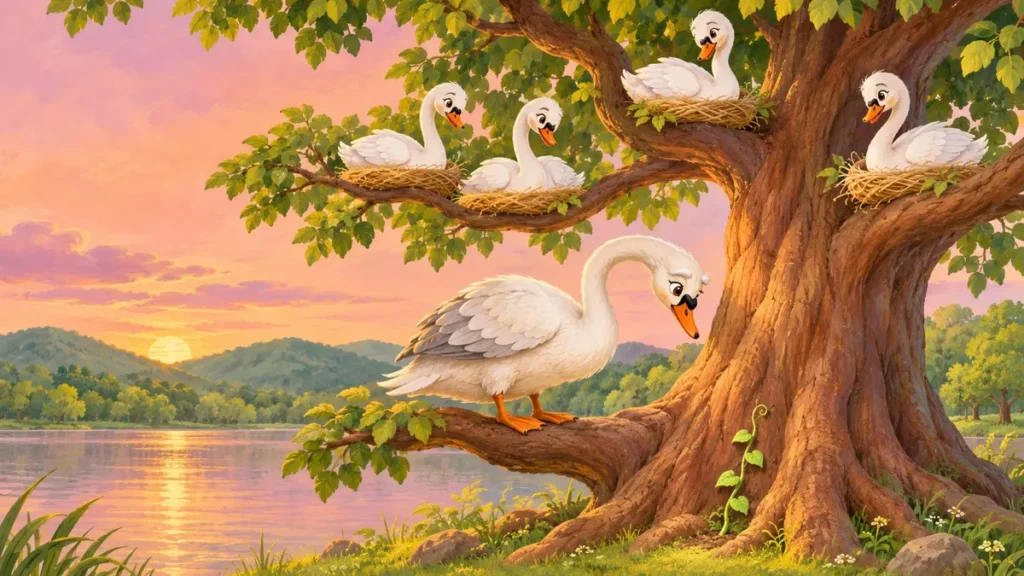
A flock of swans lived in a great tall tree beside a lake. The oldest swan was wise and watched everything carefully. One day she saw a small vine starting to climb up the trunk.
“Let us pull that vine out while it is small,” she said. “If it grows, someone could use it to climb up to our nests.” But the young swans laughed. “It is only a tiny vine,” they said.
The vine grew thicker and stronger. One day, while the swans were away feeding, a hunter climbed up it and spread a net over the branches. In the evening, the swans flew home and were caught.
“Now what shall we do?” they cried. The old swan said, “Listen carefully. When the hunter comes, lie very still, as if you are fast asleep. Do not move until I say so.”
In the morning the hunter climbed up, saw the still swans and thought they were no use to him. One by one he took them out of the net and dropped them gently on the ground.
When the last swan was out, the old swan called, “Now!” The whole flock rose into the air and flew away to safety. After that, the young swans always listened to her advice.
The moral of the story
Small problems are easiest to fix early, and wise advice is worth listening to.
Talk about it
- What did the old swan notice that the others ignored?
- How did her plan help the flock escape?
- Who gives you good advice, and do you listen?
Tips for reading aloud
- Use a different voice for each animal.
- Pause before the turning point and ask, “What do you think happens next?”
- Open the picture book and press Read to me to hear it read aloud, with the pages turning by themselves.
More fables: the Panchatantra bookshelf.