Hindu, Maharashtra and Goa (Konkani)
Gudi Padwa
Also called Samvatsar Padvo, Marathi New Year
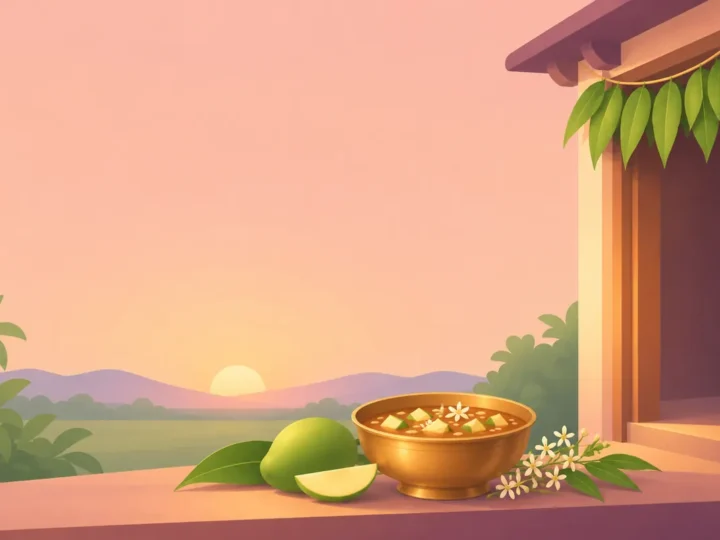
Gudi Padwa is the Marathi and Konkani New Year. Families raise a gudi outside the house: a bamboo pole topped with an upturned pot and a bright silk cloth, neem leaves, flowers and a sugar garland. The day begins with a bitter-sweet neem paste and ends with shrikhand and puran poli.
Why it is celebrated
It begins the lunar new year of the Shalivahana calendar followed in Maharashtra, and the start of spring.
The gudi is a flag of victory and good fortune; many remember Rama’s return to Ayodhya or the Shalivahana king’s victory.
The stories behind it
Brahma begins creation
A Puranic tradition holds that Brahma began creating the world on the first day of Chaitra, so many communities begin the year on this day.
What people do
- Raising the gudi at a window or door, tilted outward
- Eating neem leaves with jaggery to accept the bitter and sweet of the year
- Rangoli and toran of mango leaves
- Shobha yatras (processions) in traditional dress in Mumbai, Thane and Pune
- Buying gold or starting new ventures
Joining in for the first time
- “Gudi Padwyachya hardik shubhechha” is the Marathi greeting
- Processions welcome spectators; women often wear nauvari saris
Raising a gudi
- Take a bamboo pole and wash it.
- Tie a bright silk or cotton cloth, often green or yellow, at the top.
- Add sprigs of neem and mango leaves, a garland of flowers and a garland of sugar crystals (gathi).
- Place an upturned copper, silver or brass pot over the top.
- Stand the gudi at a window, balcony or beside the door, tilted outwards, and worship it with haldi-kumkum and a lamp.
- Take it down before sunset.
What it stands for
Families give different meanings to the gudi: a flag of victory, a sign of good fortune, a welcome to the new year and the spring, or a memory of Rama’s return to Ayodhya. The neem stands for health and the sugar garland for sweetness in the year ahead.
Processions
In cities such as Mumbai, Thane, Pune and Nagpur, shobha yatras fill the streets on the morning of Gudi Padwa. People dress in traditional clothes, women in nauvari saris and men in kurtas and pheta turbans, with dhol-tasha drum groups, lezim dancers and floats. Many Marathi associations abroad hold a gudi raising and a cultural programme.
At home and beyond
Make puran poli or shrikhand-puri for the festive meal. The same day is Ugadi in Karnataka, Andhra Pradesh and Telangana, Cheti Chand for Sindhis, and the first day of Chaitra Navratri.
Questions people ask
Is it the same as Ugadi?
It falls on the same day; Ugadi is the Telugu and Kannada new year.
Read next
Sources
Customs differ between families, communities and regions. This page describes common practice; your family or temple may do things differently.