
Hindu
Navratri
Also called Sharad Navratri, Navaratri, Navarathri
Navratri, “nine nights”, is the great autumn festival of the goddess. Across India she is worshipped in her many forms: in Gujarat with nights of Garba and Dandiya Raas, in Bengal as Durga Puja, in the South with Golu displays of dolls and the worship of Saraswati, and in the North with Ramlila plays leading to Dussehra.
Why it is celebrated
Navratri celebrates the victory of the goddess over evil, told in the Devi Mahatmya, and the power of the divine feminine.
It is divided into three sets of three nights, often for Durga, Lakshmi and Saraswati.
The stories behind it
Durga and Mahishasura
The buffalo-demon Mahishasura could not be killed by any man or god. The gods combined their powers to create Durga, who rode a lion and fought him for nine days, slaying him on the tenth.
What people do
- Ghatasthapana: setting up a kalash on the first day
- Garba and Dandiya Raas in Gujarat and across the diaspora
- Golu (Bommai Kolu) in Tamil Nadu, Karnataka and Andhra Pradesh
- Fasting, wearing a different colour each day in Maharashtra
- Kanya puja on Ashtami or Navami; Saraswati and Ayudha puja in the South
Across India and beyond
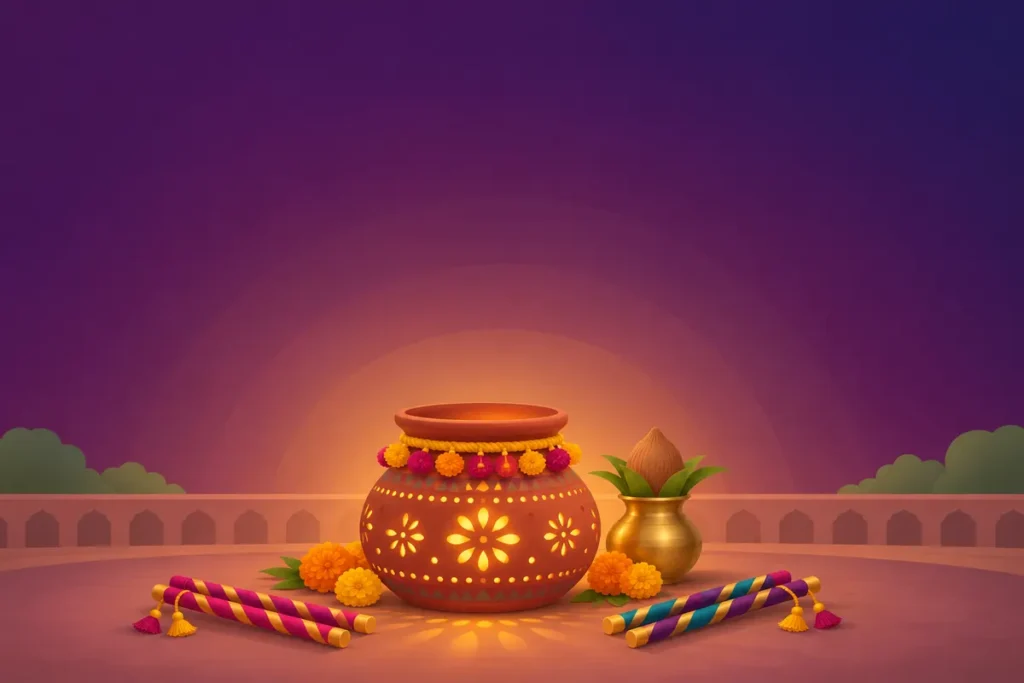
Nightly Garba around the garbo, a pot with a lamp
Durga Puja
Ramlila and Dussehra
Golu, Saraswati Puja and Vijayadashami, when children begin learning (Vidyarambham)
Joining in for the first time
- Garba nights welcome beginners; the circular steps are easy to pick up
- If you visit a Golu, you may be offered sundal and small gifts
Questions people ask
Why nine nights?
Each night honours a form of the goddess, ending with the tenth day of victory.
Read next
Sources
Customs differ between families, communities and regions. This page describes common practice; your family or temple may do things differently.