Also available in: ગુજરાતી · हिन्दी
Children are often naturally good at being in the moment. Meditation and mindfulness for kids is mostly about building on that: short, playful practices that help them notice their breath, their body and how they feel. The Raising Children Network, an Australian Government-funded parenting site, notes that mindfulness may help children and teenagers reduce stress and manage emotions, and that the more you practise, the more benefit you get. Keep it short, playful and never forced.
A 5-minute meditation to do together
- Get comfy. Sit or lie down somewhere quiet. Eyes closed, or looking softly at the floor.
- Breathe. Notice your tummy and chest moving. Feel the air: cool coming in, warm going out.
- Listen. Notice sounds close by, then sounds far away. What is the quietest sound you can hear?
- Come back. Wiggle your fingers and toes, notice the room around you, and open your eyes.
This follows the breathe, listen, return pattern suggested by the Raising Children Network.
Playful breathing games
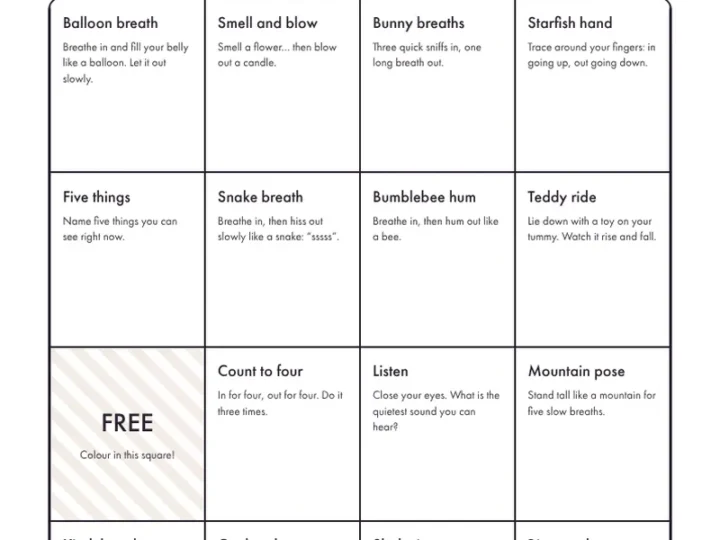
- Bubble or balloon breath: breathe in slowly through the nose, filling your tummy like a balloon, then blow out gently as if blowing a big bubble.
- Smell the flower, blow out the candle: a slow sniff in, a long blow out.
- Starfish hand: spread one hand like a starfish. Trace up each finger as you breathe in, and down as you breathe out.
- Teddy ride: lie down with a soft toy on your tummy and watch it rise and fall.
- Bumblebee hum: breathe in, then hum on the way out.
- Feelings colours: ask, “What colour is your feeling right now?” and talk about it together.
Print our free breathing bingo card to turn these into a game.
Activities by age
- Under 6: one or two minutes, with movement, toys and stories, done together: bubble breathing, smelling a flower and blowing out a candle, a “statue” game where everyone freezes and listens.
- 6 to 8: starfish hand breathing, a listening walk, a glitter jar to watch settle.
- 9 to 12: three to five minutes: a short body scan, a gratitude jar, mindful colouring, counting breaths to ten.
- Teens: let them choose: box breathing before exams, journaling, a mindful walk, music or the meditation timer. Invite rather than insist.
When feelings are big
- Stay calm yourself, and get down to your child’s level.
- Name the feeling: “You’re really cross.”
- Offer a calming activity: “Shall we do five bubble breaths together?”
- Talk about what happened once everyone is calm. Every feeling is okay: the aim is to notice, not to make feelings go away.
Try the breathing games when everyone is calm first, so they are familiar when emotions run high. A calm corner at home helps too.
A ten-minute family calm routine
Doing a short practice together can become a lovely family ritual, a few calm minutes before school, after dinner or on the weekend.
- Arrive (1 minute). Sit together in a circle. Everyone takes three slow breaths.
- Stretch (3 minutes). Reach up tall like a mountain, sway like a tree, then curl up small in child’s pose.
- Check in (3 minutes). Each person shares their feelings colour.
- Thank (2 minutes). Each person names one thing they are grateful for. The gratitude journal page is a nice place to record them.
- Close (1 minute). One long, slow breath out together.
Let children take turns leading, and stop while it is still fun.
Calm moments through the day
| Time | Idea |
|---|---|
| Morning | Three breaths together before leaving the house |
| After school | A snack and ten minutes of quiet before homework, or one minute of breathing to start |
| Dinner | Each person shares one good thing |
| Weekend | A gratitude walk, cooking together, or the sand garden |
| Bedtime | A story and a short breathing practice: see a calm bedtime routine for kids |
Make it a habit
- Link it to something that already happens, such as after brushing teeth or before a story.
- Join in. Children copy what they see. Praise the effort, not the result.
- Keep it light. A wriggly, giggly minute still counts.
- When life gets busy, keep one anchor, such as the dinner round, and rebuild from there.
For stories with a gentle lesson, open our Panchatantra stories.
Common questions
What age can children start?
Even preschoolers can enjoy a minute of playful breathing or listening. Formal sitting meditation usually suits school-age children better. Keep sessions short and fun: one to two minutes for young children and up to about five minutes for school-age children.
What if my child won’t sit still?
That is normal. Try moving practices instead: slow walking, stretching, or a toy rising and falling on their tummy as they breathe.
Should I make my child do it?
Invite rather than insist. Doing it yourself, alongside them, is often the best encouragement.
Is meditation safe for kids?
Simple breathing and listening practices are generally low risk. If a child becomes upset during meditation, stop, comfort them and talk about it. Consider speaking to your GP or a school counsellor if worries persist.
Key points
- Short, playful and age-appropriate.
- Use breathing games when feelings are big.
- Practise alongside your child and add small calm moments to times you already share.